

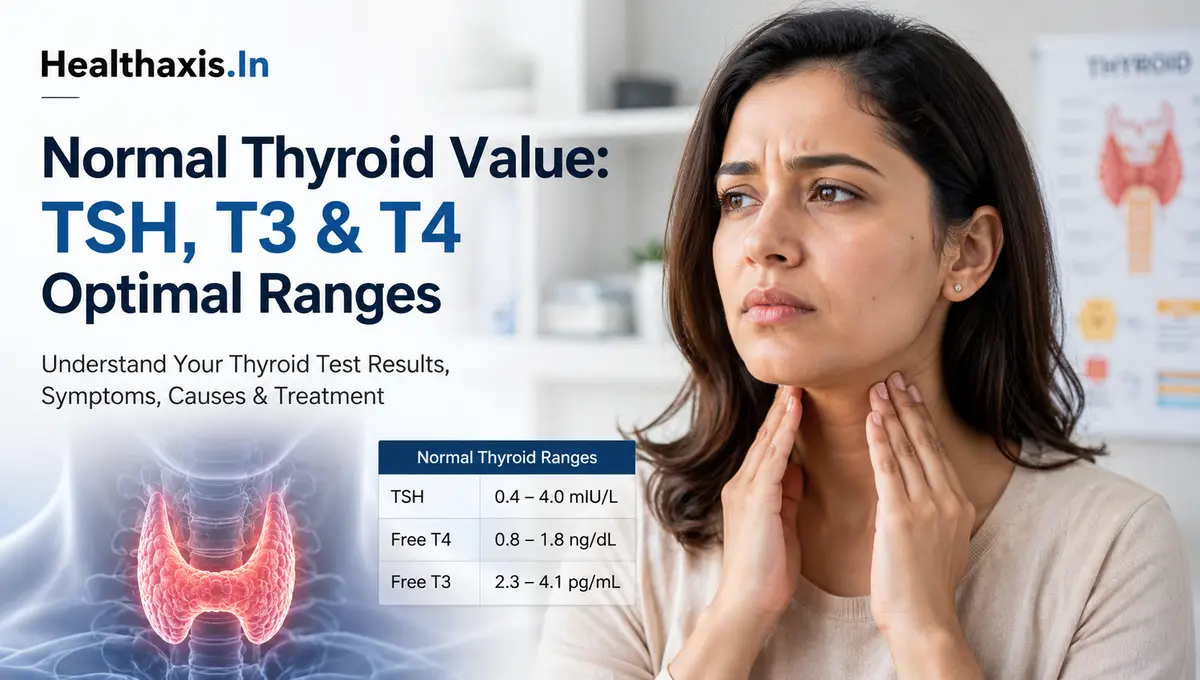
Understanding your normal thyroid value is essential for maintaining your energy, metabolism, and overall well-being. A standard adult blood profile typically shows a TSH level between 0.4 and 4.0 mIU/L, though optimal ranges can vary slightly based on age and pregnancy. When your laboratory results fall outside these parameters, it indicates a potential imbalance in how your body regulates vital functions. This guide breaks down exactly what your test numbers mean, why your thyroid value matters, and how these hormones impact your daily health.
Key Highlights & Quick Facts
- A standard TSH level ranges from 0.4 to 4.0 mIU/L for most healthy adults.
- High TSH often indicates an underactive gland (hypothyroidism), while low TSH suggests an overactive gland (hyperthyroidism).
- Common symptoms of an abnormal thyroid value include unexplained weight changes, severe fatigue, and sudden mood swings.
- Autoimmune conditions, such as Hashimoto’s and Graves’ disease, are the primary causes of irregular test results.
- Women, individuals over 60, and those with a family history of autoimmune diseases are at a significantly higher risk.
- Treatment typically involves daily oral medications to either replace missing hormones or suppress excess production.
- Fasting is generally not mandatory for a blood draw, but morning testing provides the most accurate thyroid value.
- Consult an endocrinologist immediately if you experience a rapid heartbeat, sudden weight loss, or visible swelling in your neck.
Understanding Your Normal Thyroid Value and Lab Results
A comprehensive profile measures how well the butterfly-shaped gland in your lower neck is functioning. The term thyroid value refers to the specific numerical measurements generated from a routine blood test. Doctors rely on these numbers to diagnose underlying metabolic issues before severe physical complications arise.
Monitoring your thyroid value regularly helps in maintaining optimal health over time. Even slight deviations from the normal range can drastically alter how your cells utilize energy. Keeping a record of your past lab reports helps you and your doctor track any progressive changes.
What Are TSH, T3, and T4 in a Comprehensive Thyroid Profile?
A complete laboratory panel tests for Thyroid Stimulating Hormone (TSH), Triiodothyronine (T3), and Thyroxine (T4). TSH is actually produced by the pituitary gland in your brain to tell your thyroid gland exactly how much hormone to manufacture. T4 and T3 are the actual metabolic hormones produced to control your body’s daily energy usage.
A disruption in one of these markers usually leads to an immediate shift in the others. Understanding the relationship between these three specific markers is the key to interpreting your overall thyroid value correctly.
The Exact Normal Range for TSH Explained
For a healthy, non-pregnant adult, the standard TSH range is typically between 0.4 and 4.0 mIU/L. However, many endocrinologists prefer to see a narrower optimal range of 0.5 to 2.5 mIU/L for patients who are already receiving active treatment. Older adults may naturally maintain a slightly higher baseline without requiring any medical intervention.
It is crucial to evaluate your specific thyroid value against the reference range provided by your testing laboratory. Different diagnostic labs use slightly different equipment, which can cause minor variations in what is considered a perfectly normal reading.
Optimal Levels for Total and Free T3 and T4
T3 and T4 exist in your bloodstream in two distinct forms: bound to proteins and free-floating. Free T4 (FT4) and Free T3 (FT3) are the active, unbound forms that your body’s tissues can readily absorb and use. The normal range for Free T4 usually falls between 0.8 and 1.8 ng/dL.
For Free T3, a healthy level typically rests between 2.3 and 4.1 pg/mL. Analyzing these specific unbound numbers helps doctors pinpoint exactly where the glandular communication is failing. Knowing your free hormone levels provides a much more accurate thyroid value than testing total bound hormones alone.
What High TSH and Low T4 Tell Us About Hypothyroidism
When your pituitary gland senses that metabolic hormone levels are dropping, it pumps out more TSH to stimulate production. If your lab report shows a high TSH alongside a low Free T4, you are likely dealing with primary hypothyroidism. This indicates that your gland is underactive, sluggish, and failing to produce sufficient hormones.
Left untreated, an underactive state significantly slows down your body’s natural processes, impacting everything from digestion to heart rate. Restoring a normal thyroid value in this scenario usually requires taking daily synthetic hormone replacement pills.
What Low TSH and High T4 Tell Us About Hyperthyroidism
Conversely, if your gland produces too much hormone independently, the pituitary gland stops making TSH entirely. A low or undetectable TSH paired with a high Free T4 or Free T3 points directly to hyperthyroidism. This overactive state accelerates your metabolism to highly uncomfortable and potentially dangerous speeds.
Prompt medical intervention is necessary to slow down hormone production and protect your cardiovascular system. Doctors utilize anti-thyroid medications, radioactive iodine, or surgery to bring your thyroid value back down to a safe baseline.
Common Causes Behind an Abnormal Thyroid Value
Autoimmune diseases are the leading culprits behind glandular dysfunction in India. Hashimoto’s thyroiditis slowly damages the gland causing an underactive state, while Graves’ disease overstimulates it. Achieving a stable thyroid value is difficult while these autoimmune attacks are actively occurring.
Other prevalent causes include severe dietary iodine deficiency, benign structural nodules, sudden viral inflammation, and the side effects of certain medications. Identifying the exact root cause is vital for determining the safest and most effective long-term treatment plan.
Recognizing the Physical Symptoms of a Thyroid Imbalance
The physical signs of a problem depend entirely on whether your metabolism is running too fast or too slow. Paying close attention to these daily physical changes helps you know exactly when to request a blood test.
- Hypothyroidism symptoms: Chronic fatigue, unexplained weight gain, feeling constantly cold, extremely dry skin, severe constipation, and diffuse hair loss.
- Hyperthyroidism symptoms: A rapid or irregular heart rate, sudden weight loss despite increased appetite, high anxiety, hand tremors, excessive sweating, and frequent bowel movements.
Who Should Get Screened for Thyroid Disorders?
Routine screening is highly recommended for women over the age of 35, as they are disproportionately affected by these metabolic disorders. Pregnant women or those actively planning to conceive must also monitor their hormone levels closely to ensure proper fetal brain development. Maintaining a healthy thyroid value during pregnancy is absolutely critical for both the mother and the baby.
Anyone with a family history of autoimmune disease, Type 1 diabetes, or a history of radiation to the neck should undergo regular laboratory testing. Early detection prevents minor hormonal imbalances from developing into severe, long-lasting health complications.
How to Properly Prepare for Your Thyroid Blood Test
Getting an accurate thyroid value requires minimal preparation, but specific timing can be important for the best results. Most doctors recommend having your blood drawn early in the morning because TSH levels naturally peak and fluctuate throughout the day. Fasting is usually not strictly required unless your physician is simultaneously checking your cholesterol or fasting blood sugar levels.
However, if you are already taking daily hormone replacement medication, ask your doctor for specific instructions. Some endocrinologists prefer you wait to take your morning pill until immediately after the blood draw to ensure an untainted reading.
Next Steps and When to Consult a Doctor About Your Report
Never attempt to self-diagnose or alter your medication dosages based purely on reading a laboratory report. If any single result falls outside the standard range, schedule an appointment with a general physician or a specialized endocrinologist. They are trained to interpret your specific thyroid value alongside your physical symptoms and personal medical history.
Your doctor may order an ultrasound of your neck or specific antibody tests to complete the diagnosis. Always rely on professional medical advice to ensure you receive a safe, effective, and personalized treatment plan.
Frequently Asked Questions (FAQs)
Can high stress levels affect my thyroid blood test results?
Yes, severe physical trauma or prolonged emotional stress can temporarily alter hormone production and impact your test numbers. However, stress alone rarely causes a permanent clinical disease, though it can trigger underlying autoimmune conditions.
Is a thyroid disorder completely curable?
Most conditions, especially those caused by autoimmune diseases, are not completely curable but they are highly manageable. With the correct daily medication and simple lifestyle adjustments, patients can maintain a normal thyroid value and live healthy lives.
Does my daily diet affect my hormone levels?
Dietary choices play a supporting role in maintaining glandular health. Adequate intake of iodine, selenium, and zinc is important for hormone synthesis, but diet alone cannot reverse or cure an active autoimmune disease.
Why does my doctor only test my TSH instead of all three markers?
TSH is considered the most sensitive and reliable initial marker for assessing overall function. If your TSH is strictly within the normal range, it usually indicates that your T3 and T4 levels are also stable, making further expensive testing unnecessary.
How often should I check my levels if I am currently on medication?
When starting a new medication or adjusting a dosage, doctors typically require you to retest every 6 to 8 weeks. Once your numbers stabilize in an optimal range, checking your blood levels once or twice a year is generally sufficient.
Read More: Thyroid Symptoms In Hindi

1 Comment
Pingback: Thyroid Gland Diagram: A Detailed Visual Anatomy Guide | Healthaxis.In